E. coli response for community-run drinking water supplies
How to protect people’s health and prevent E. coli in drinking water
This guidance is for people who manage drinking water supplies that don’t need to register with the Water Services Authority - Taumata Arowai yet or at all.
Information on this page can help registered drinking water suppliers respond to an E. coli detection, but make sure you understand additional responsibilities for your supply.
To understand your water supply and legal responsibilities, use the ‘What type of water supply do you provide?’ assessment tool.
Act quickly
When Escherichia coli (E. coli) is detected in drinking water, anyone who drinks the water could get sick.
If E. coli is found in the drinking water you supply, act quickly to protect people’s health and prevent contamination in the future.
These are the first steps to take.
- Make sure nobody drinks the water without boiling it first. Boiled water should be used to drink, mix baby formula, brush teeth, prepare food, wash dishes by hand, make ice, clean and give to pets. Use boiled water until the problem is resolved.
- If you supply water to other people, use a Boil Water notice to let them know water needs to be boiled before use.
- Fix any issues in your water storage and treatment system.
Address issues and prevent future contamination
If you haven't been using a treatment system, anyone drinking water from taps connected to your water supply could become ill from harmful microscopic bugs at any time.
Testing your water will not make it safe to drink. A treatment system is essential for safe water. A system with filters and UV light will remove or inactivate harmful microscopic bugs. How you store and move water is also important. Testing helps you check if the treatment system is doing its job and storage is safe.
Take E. coli seriously
E. coli is a bacteria often found in the gut of animals. A positive E. coli test means there is faeces (poo) from animals, birds or people in the water.
When E. coli shows up in drinking water, it means a range of other harmful bugs carried in poo could be present too.
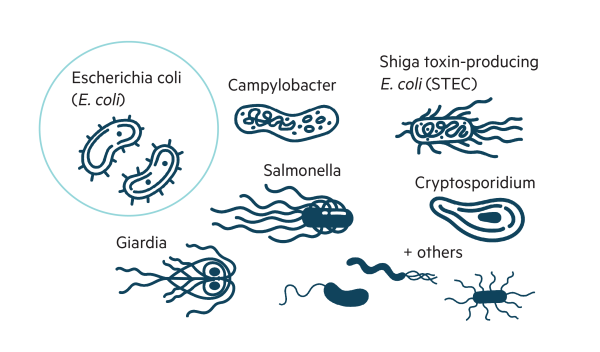
These microscopic bugs can cause vomiting, diarrhoea, fever and stomach cramps. Symptoms like this normally resolve in 2-14 days but some people experience long-lasting health impacts. Drinking contaminated water can lead to people being hospitalised or even dying. Children, the elderly and people with health conditions are usually at higher risk.
Anyone with symptoms should contact their usual GP, hauora or healthcare provider, or call Healthline for free on 0800 611 116.
Understand how contamination happens
E. coli and other harmful bugs get into drinking water when poo particles find their way into source water and/or infrastructure like storage tanks or water pipes.
Many activities can cause contaminants to enter water. This is why treatment is so important – it’s the only way you can be confident water is safe to drink.
All water sources can be affected by contamination from harmful microscopic bugs.
For rivers, lakes, streams and creeks
Risks to rivers, lakes, streams and creeks
- Farming nearby could mean poo from animals makes its way into water.
- People swimming or boating upstream of the water intake could poo, dump waste or disturb silt.
- Heavy rain could wash poo and dirt into waterways and cause cloudiness called turbidity. If water is too turbid, filters and UV treatment can’t do their jobs properly.
- Logging or land clearing could cause soil to slip into water, increasing turbidity.
- Leaky pipes carrying wastewater or stormwater could introduce contamination.
Manage risks in future
- Check your water source and surrounding areas often and keep an eye out for any changes that might bring risk.
- Use an effective treatment system with filtration and UV light.
- Make sure your treatment system is equipped to manage turbidity.
- Check and clean tanks.
For roof water
Risks to roof water
- Poo from animals like birds or possums could be washed off the roof and into storage tanks when it rains.
- A bird, mouse or other small animal could get into a storage tank if it isn’t secured and kept in good condition.
- Sediment building up at the bottom of a tank could contain harmful microscopic bugs.
Manage risks in future
- Keep your roof clean
- Stop birds and animals from accessing the roof or getting into tanks. This could include cutting back any overhanging branches.
- Check and clean tanks.
- Use an effective treatment system with filtration and UV light.
For bores and underground springs
Risks to bores and underground springs
- Bores less than 30 metres deep can be more prone to contamination because they are nearer to the surface and to other water sources. Contamination can happen in bores of any depth.
- A poorly covered or maintained bore could lead to contamination entering the water you’re collecting.
- Poo from farm animals could contaminate a poorly covered bore.
- Farm animals or activities could damage infrastructure protecting the bore and let contaminants in.
- Because water is coming from underground, bores can be contaminated by nearby activities and infrastructure including sewage disposal fields, septic tanks, effluent discharge, underground storage tanks, waste ponds, landfills, offal pits and pesticides.
Manage risks in future
- Make sure the bore is sealed, with no holes where contamination could enter through rainwater or surface water. You can concrete around the bore to protect it.
- Keep animals at least five metres away from bore infrastructure like pumps, covers and casing.
- Be aware of how land around your source water is used and any risks connected with activities or infrastructure.
- Use an effective treatment system with filtration and UV light.
- Check and clean tanks.
Address issues and prevent future contamination
Work through these steps to understand your situation and keep E. coli and other harmful bugs out of your drinking water.
Use the right treatment system
If you don't treat your water before drinking it, a lack of treatment system is the likely cause of contamination in your drinking water.
Install an effective treatment system to address this issue. Consult a local drinking water professional if you need help.
Recommended treatment for all water supplies
An effective treatment system for a single house or small community is normally made up of cartridge filtration and ultraviolet (UV) light disinfection.
Cartridge filters remove dirt, insects and floating sediment from water. They prepare water for other treatment processes, including disinfection by UV light. It’s best to use at least one cartridge filter with a pore size of five microns or less.
UV light disinfection inactivates microscopic bugs in the water. Effective UV treatment relies on the intensity of the light, how fast water is moving through the unit and how long water is exposed to light.
The UV system should:
- deliver a minimum reduction equivalent dose of 40mJ/cm2
- restrict or monitor the flow of water through UV treatment so it meets the manufacturer’s recommended flow rate.
A plumber can install a flow restrictor to help your system achieve the right flow rate.
It can be useful to consult a local drinking water professional for help figuring out the treatment system best suited to your source water.
For source water with turbidity issues (cloudiness or haze)
Treatment systems need to be able to properly filter and disinfect your source water on its worst days. The quality of source water from a river, creek or lake can change quickly.
Make sure your system is equipped to manage high turbidity after weather events like floods and storms.
Extra treatment steps like these can also extend the life of your 5-micron filter.
- Extra cartridge filters. If your source water is cloudy or hazy, one five-micron cartridge filter might not be enough to clear the water of dirt and other particles. Extra cartridge filters installed ahead of the five-micron filter will help to reduce turbidity so UV light disinfection can reach and inactivate all harmful bugs.
- Sand filters. If your source water is very cloudy you might need to install a filter that uses sand or other media. This will catch solid particles floating in water.
- Settling tanks. If your source water is cloudy or hazy, a storage tank installed ahead of other treatment equipment can give larger particles of sand, silt and dirt a chance to settle to the bottom.
For supplies that move treated water through pipes
If water is piped somewhere else for use after treatment, e.g. to other buildings or to provide water for stock, there is a risk that water carrying contaminants like harmful bacteria or chemicals could flow backwards into your drinking water.
Backflow prevention stops contaminated water flowing back into treated water.
There are two main types of backflow prevention.
- Air gap backflow prevention. If you have a water storage tank, an air gap uses gravity to make sure contaminated water can’t make its way back into a drinking water supply.
- Valve backflow prevention. A valve is installed as a connection between pipes. The valve has physical barriers to stop water moving backwards.
For ‘hard’ water high in calcium, magnesium and other trace metals
- Water softener. Calcium, magnesium and other trace metals can build up on the sleeve surrounding UV lamps used for disinfection. Over time this build-up stops UV systems from working. A softener device installed between the filtration and UV processes can enable proper treatment and extend the life of UV lamps.
For water that is discoloured, odorous or tastes unpleasant
- Carbon filters. Discolouration from naturally occurring metals and tannins in water can stop UV lamps from working properly and allow harmful bugs into drinking water. A carbon filter absorbs discolouration and can improve the odour and taste of water. They need to be installed between two cartridge filters.
Some metals can dissolve in water, making particles too fine for carbon filters to catch. If your water is very discoloured or is causing stains to your sink or clothes, you might need to seek professional advice to solve the problem.
If you need to purchase new equipment, make sure you check the legal requirements for your drinking water supply first.
Depending how many people you supply water for and whether water is provided for the public, you might be legally required to use specific parts in your treatment system. See the ‘What type of water supply do you provide?’ assessment tool to learn more.
Check and maintain your treatment system
If you have a treatment system, an E. coli detection in drinking water could mean something important is broken, not working or missing.
Make sure equipment used to treat and share water is maintained properly.
The checks to make depend on the parts in your treatment system. Useful checks and maintenance tips for specific parts are outlined below.
UV light disinfection
Checks to make
- UV unit should be switched on.
- UV lamp quartz sleeve should be clean.
- UV lamp should be current (not expired).
- The flow rate of water should meet the manufacturer’s recommendation. Effective UV treatment relies on the intensity of the light, how fast water is moving through the unit and how long water is exposed to light.
Keep UV disinfection working
- Change your UV lamp at least once a year. Most systems have a counter that will tell you when replacement is due. If the expiry date has passed, change the lamp.
- Check your UV lamp sleeve at least once a year, and more frequently if your water is high in minerals. It should be clean and in good condition. If there is any build-up, clean it away with a damp cloth. A non-abrasive cleaner can be used for stubborn build-up.
- If the sleeve is damaged, swap it out for a new one.
Chlorine added by dosing pump
Checks to make
- Hypochlorite solutions should be stored and used in line with the manufacturer’s instructions.
- Chlorine dosing unit should be switched on.
- Water should be flowing through the dosing system.
- There should be no blockages, leaks, disconnections or kinks in tubes.
- There should be chlorine in the container that feeds the pump.
- The dosing unit should be in good condition, with no loose fittings or corrosion.
- Dosing should be high enough to maintain free available chlorine (FAC) levels throughout your drinking water system. FAC should ideally be above 0.2mg/L (parts per million) throughout. It should not fall below 0.1mg/L.
Keep chlorine dosing pumps working
- Check the concentration of FAC throughout your drinking water supply at least twice a week. Make sure you check the taps furthest from the treatment point or treated water storage tanks. FAC should ideally be above 0.2mg/L (parts per million) throughout. It should not fall below 0.1mg/L. You might need to adjust dosing to maintain these levels.
- You can use chlorine dip strips or a small FAC-checking device. Devices are usually more accurate than strips.
- If chlorine is a normal part of your water treatment, an unexpected drop in chlorine levels in drinking water could indicate there is contamination coming from a local source. Investigate what might be causing this and increase chlorine dosing to manage the risk.
Chlorine added to a storage tank
Checks to make
- The amount of chlorine used should be correct for the amount of water you want to disinfect.
- Dosing should be high enough to maintain free available chlorine (FAC) levels throughout your drinking water system. FAC should ideally be above 0.2mg/L (parts per million) throughout. It should not fall below 0.1mg/L.
Keep chlorine working
- Check the concentration of FAC throughout your drinking water supply at least twice a week. Make sure you check the taps furthest from the treatment point or treated water storage tanks. FAC should ideally be above 0.2mg/L (parts per million) throughout. It should not fall below 0.1mg/L.
- You can use chlorine dip strips or a small FAC-checking device. Devices are usually more accurate than strips.
- After dosing, chlorine should have at least 30 minutes in your tank before water is used.
See page 34 of this Household Water Supplies guidance for more dosage information.
Cartridge filter
Checks to make
- Water flow should be normal. If flow is slowing down, filters might be blocked.
- Filters should look clean around the centre. Unscrew the filter from its housing. Every filter is different but you should be able to see if dirt is getting close to the middle.
Keep filters working
- Check your filters every month and after weather events like floods, storms, fires and high winds.
- If you have a pressure gauge, check it at least once a week.
- Replace filters if the centre is starting to look dirty or you notice a drop in water pressure at the tap or on a gauge.
- If you find your cartridge filter needs changing more than once a month, you might need to install extra filters.
- Depending on the quality of your source water, filters should normally last between six and 12 months.
Membrane filters
If you have membrane filtration, make sure the filter is the correct type for the contamination you want to filter out.
- Microfiltration (pore size 0.1 – 10 micrometres (µm) can remove larger harmful bugs. Additional treatment would be required to remove or inactivate smaller bacteria and viruses.
- Ultrafiltration (pore size 0.01 – 0.1 µm) can remove bacteria, viruses and large molecules.
- Nanofiltration (pore size 0.001 – 0.01 µm) can remove pathogens, smaller organic molecules and salts.
- Reverse osmosis (pore size less than 0.001 µm) will remove all pathogens plus salts and ions.
Checks to make
- Membrane filters should be the correct type for the size of particle you want to filter out.
- The filter’s power should be switched on.
- Water pressure should be in line with the requirements for your filter.
- If there is a pressurised storage tank, the pressure should be in line with the manufacturer’s instructions.
- The unit should not be used for longer than it is designed to last. Check the manufacturer's instructions.
- Pipes and tubes attached to the membrane filter system should be in good condition.
Keep membrane filters working
- Clean and sanitise the system at least once a year.
- Replace the system’s sediment and carbon filters every six to 12 months.
- Replace the membrane every two to five years.
Chlorine does not get rid of all contamination in water. It cannot remove protozoa – a group of tiny single-celled organisms that includes disease-causing parasites like cryptosporidium. A positive E. coli test in drinking water means there might be protozoa in the water too.
Most drinking water needs additional treatment like UV disinfection or cartridge filtration using a pore size of one micron or smaller.
Keep pipes, storage tanks and pumps safe
If your treatment system is working, an E. coli detection in drinking water might be linked to issues in the way water is stored or shared.
What to check
Pipes
Pipes should be in good condition. Leaks or breaks after treatment can let E. coli and other harmful microscopic bugs into your drinking water.
Storage tanks for treated water
Tanks should be clean and free of debris on the inside.
Tanks should be properly protected from birds, animals and other contaminants. If there are signs of contamination, empty, disinfect and refill your storage tank.
Pumps
Check pumps for any damage that could let contaminated water in.
Test your drinking water
Testing water doesn’t make it safe to drink – only an effective treatment system can give you this confidence. Testing is a great way to check if your treatment system is working properly.
Use an accredited laboratory near you.
Testing after an E. coli detection
Once you have checked and fixed any problems in your treatment system, it’s a good idea to test your drinking water for E. coli again. Use an accredited water laboratory.
Make sure your water is safe to drink before removing any Boil Water notices and using water normally.
Testing to keep water safe in the future
It’s good to test drinking water for E. coli after storms and if there is a change to how land is used near your water source.
Changes could include new farming activity, logging, building or recreation/tourism.
Monitor source water
Water is dynamic and conditions can change quickly.
To keep your drinking water safe, watch out for changes in and around your source water.
It’s a good idea to schedule regular checks so you can stay ahead of any possible contamination or new challenges.
Watch for changes to source water
Changes to look out for depend on where your water comes from.
A change could include extreme weather, new farming or industrial activity, recreational use of land or waterways and any other new circumstances that could challenge your treatment system.
If getting to your source water is difficult, it’s good to add extra protections in your treatment system to account for any changes you can’t see.
Make sure you understand the risks to your source water.
Test source water
Having source water tested by an accredited laboratory is a good way to understand the risks your treatment system needs to manage. A lab can help you decide what to test for.
Use an accredited laboratory near you.
Find help to install and maintain equipment
To find a suitable treatment system, look for a New Zealand supplier of water filters, water purifiers and ultraviolet water treatment systems. Purchasing from a local provider brings protections under the Consumer Guarantees Act and might make it easier to have servicing done when needed.
Who to go to for installation and maintenance depends on your specific situation. People who install and maintain your treatment system, monitor your source water and manage your operations should be suitably qualified, trained or experienced. Different tasks will need different skills. It’s a good idea to make a list of your requirements and check that anyone who might provide services or products is qualified to help.
A registered plumber must be used to install end-point treatment systems inside buildings. Systems must be installed in line with the manufacturer’s instructions.
Our ‘What type of water supply do you provide?’ assessment tool can help you understand the legal requirements for your drinking water supply.
Meet your responsibilities as a drinking water supplier
Your legal responsibilities as someone in charge of a drinking water supply depend on how many people you provide water for, whether water is distributed through pipes and whether you provide water for the public.
You will need to register with the Water Services Authority – Taumata Arowai if your drinking water supply meets any of these criteria.
- Supplies to 26 people or more.
- Is used for non-residential use, e.g. drinking in commercial, industrial or community settings.
If your supply was set up before the Water Services Act came into effect in 2021, you need to register by November 2028.
Drinking water supplies set up after 2021 are legally required to register with the Water Services Authority at the time they are established.
Different supply types have different responsibilities. The supply type assessment tool can help you understand what you need to do.
What type of drinking water supply do I provide?
You don’t need to register if you supply drinking water to 25 people or fewer and the water is only for domestic use. If you want to make sure your water supply is safe for people who drink from it, install an effective treatment system
Drinking water is any water supplied for drinking, brushing teeth, preparing food and drink and washing utensils.
See the Water Services Act for the full definition of drinking water.
How to register your drinking water supply
Fill in an application form. This will ask for some details about your water supply, who you supply water to and your contact information.
Once your application form has been processed, you will receive an invitation to log into Hinekōrako, our online self-service portal. You need a RealMe account to log in.
When you log in, you will add further information to your supply details and submit this for registration. You will be asked what your water source is, what treatment you use and the key relationships for your water supply.
You will receive an email when your registration is approved. This will outline your responsibilities as a water supplier and when you will need to renew your registration. Your registration needs to be renewed every five years.