Safe water every day for schools
Support the health and wellbeing of your students and school community by providing safe, reliable drinking water.
If your school/kura has its own drinking water supply, you must provide enough water and ensure it is safe through treatment, maintenance and testing.
If your water tests positive for E. coli, it’s important to act quickly.

Schools across the country are working to provide safe drinking water
Contamination happens when harmful germs, chemicals, dirt or algae get into drinking water. The bacteria Escherichia coli (E. coli) is the leading cause of contaminated drinking water for schools/kura with their own supply. You can protect against E. coli and other contamination by understanding risks to your source water and maintaining a treatment system that includes cartridge filters and UV light disinfection.
Over 440 schools supply their own drinking water. In 2025, 71 schools reported E. coli contamination. About 24 of those schools had more than one reported incident. Schools accounted for 53% of all E. coli contamination reported to the Water Services Authority - Taumata Arowai. The Ministry of Education is working with schools on upgrades to improve the safety of drinking water, starting with schools that have had repeated issues with E. coli. Steps outlined on this page can help all school/kura leaders learn more and take action.
Te Waha o Rerekohu Area School, in the rural township of Te Araroa on the East Coast, experienced frequent E. coli contamination in its drinking water supply. This could have been caused by bird faeces (poo) on the roofs that water is collected from, and/or contamination getting into aging storage tanks. Through system upgrades, regular maintenance and water testing, the school now consistently provides safe water for students and the school community.
E. coli in water
E. coli is a type of bacteria found in the intestines and poo of people and animals. It indicates faecal contamination in water.
E. coli can cause serious health complications, especially in young children, the elderly and people with weakened immune systems.
If your water tests positive for E. coli, it’s important to act quickly.
If your school/kura and its assets are owned by the Ministry of Education, see the Ministry's website for more information about how to respond when E. coli is detected in your drinking water.
What to do if testing detects contamination in your water – Ministry of Educationoutbound
Meeting legal and Ministry responsibilities
Schools supplying their own drinking water must comply with water services legislation.
Schools whose property and assets are owned by the Ministry of Education also need to meet Ministry testing and documentation requirements.
Legal responsibilities regulated by the Water Services Authority
The rules and requirements of the Water Services Act 2021 outline the responsibilities of drinking water suppliers. Schools must comply with the Act and provide safe drinking water.
Water Services Act 2021 – New Zealand Legislationoutbound
Under law, schools can choose between two compliance pathways.
- Follow the Drinking Water Quality Assurance Rules and prepare a drinking water safety plan (DWSP).
OR - Use an Acceptable Solution – a way to demonstrate compliance that involves using a pre-approved approach to treatment, maintenance and testing.
The Self-supplied Buildings Acceptable Solution will be suitable for most schools with a population under 500 people and 10 buildings or fewer. Using an Acceptable Solution needs extra consideration if your school supplies water to a neighbouring property under different ownership, e.g. a community hall or early childhood centre. The Self-supplied Buildings Acceptable Solution will not cover that property. You will need to install end-point treatment for the separate property under a different solution called the Small to Medium Networks Acceptable Solution.
Required by the Ministry of Education
Ministry requirements include:
- Test for E. coli and total coliforms every month, including during the school holidays. Report results through the ‘water testing results’ tab in the Argest portal. Three clear tests are required after a positive test.
- Prepare a Ministry drinking water safety plan in line with your source water type. Templates and guidance are on the Ministry website.
Drinking water safety plan template – Ministry of Educationoutbound
If you choose the Rules as your compliance pathway, you need to submit this plan to the Water Services Authority through the Hinekōrako self-service portal. The Ministry plan is the only DWSP you need to create.
If you choose an Acceptable Solution, you don’t need to submit your Ministry drinking water safety plan to the Authority.
The sector plan for self-supplied schools and kura summarises our expectations.
Sector plan: Self-supplied schools and kura
See the Ministry of Education website for full requirements and information including who to contact for support and how to access help to cover compliance costs.
Schools that supply their own drinking water – Ministry of Educationoutbound
If your school/kura is private or state integrated and owns its properties and assets, our ‘Find your supply type’ tool can help you learn more about your responsibilities.
Find your supply type
Manage risks to your water source
Understanding the source water for your school/kura and how it could be affected by changes in the land and water it's connected with helps you to manage contamination risk.
Ground water from springs and bores
Bore water is generally the safest water source, especially if your bore is over 30 metres deep from the surface to the top of the uppermost stone-filtering screen.
Contamination can still happen in deeper bores and it’s important to be vigilant. Check with your regional council to learn about the depth of your bore.
Risks to ground water
- A poorly covered or maintained bore could lead to contamination entering the water you’re collecting.
- Farm animals nearby could disturb infrastructure protecting the bore and let contaminants in.
- If the top of the bore is covered by flood water, it’s possible for silt, soil and harmful microscopic bugs to seep in.
- Because water is coming from underground, bores can be contaminated by nearby activities and infrastructure including sewage disposal fields, effluent discharge, underground storage tanks, waste ponds, landfills, offal pits and pesticides.
How to prevent contamination
- Make sure the bore is sealed, with no holes where contamination could enter through rainwater or surface water. You can concrete around the bore to protect it.
- Keep animals at least five metres away from bore infrastructure like pumps, covers and casing.
- Be aware of how land around your source water is used and any risks connected with activities or infrastructure.
- Use an effective treatment system with filtration and UV light.
Roof water collected when it rains
Roof water is exposed to risks.
Risks to roof water
- Poo from animals like birds or possums could be washed off the roof and into storage tanks when it rains.
- A bird, mouse or other small animal could get into a storage tank if it isn’t secured and kept in good condition.
- Tennis balls or similar on the roof can block downpipes and interrupt water supply.
- Wind can carry contaminants onto the roof.
- Sediment building up at the bottom of a tank could contain harmful microscopic bugs.
- If there is lead in nails, paint or other roofing materials, toxins could leach out into water.
How to prevent contamination
- Keep your roof clean.
- Stop birds and animals from accessing the roof or getting into tanks. This could include cutting back any overhanging branches.
- Clear leaf screens and flush diverters after rain.
- Check and clean tanks.
- Make sure materials used in roofing are lead-free.
- Use an effective treatment system with filtration and UV light.
Surface water from rivers, streams and lakes
Surface water is exposed to risks and needs to be monitored.
Risks to surface water
- Farming nearby could mean poo from animals makes its way into water.
- People swimming or boating upstream of the water intake could poo, dump waste or disturb silt.
- Heavy rain could wash poo and soil into waterways and cause cloudiness from disturbed dirt, called turbidity. If water is too turbid, filters and UV treatment can’t do their jobs properly.
- Logging or land clearing could cause soil to slip into water, increasing turbidity.
- Blue-green algae can introduce toxins that are dangerous to people and animals.
- Pipes carrying wastewater or stormwater could introduce contamination.
How to prevent contamination
- Check your water source and surrounding areas often and keep an eye out for any changes that might bring risk.
- Use an effective treatment system with filtration and UV light.
- Make sure your treatment system is equipped to manage turbidity.
Treat water to make it safe to drink
Water treatment is not a ‘set and forget’ activity. A treatment system includes some key equipment which should last for many years, but parts need to be checked and replaced to keep a system in good working order.

Cartridge filters
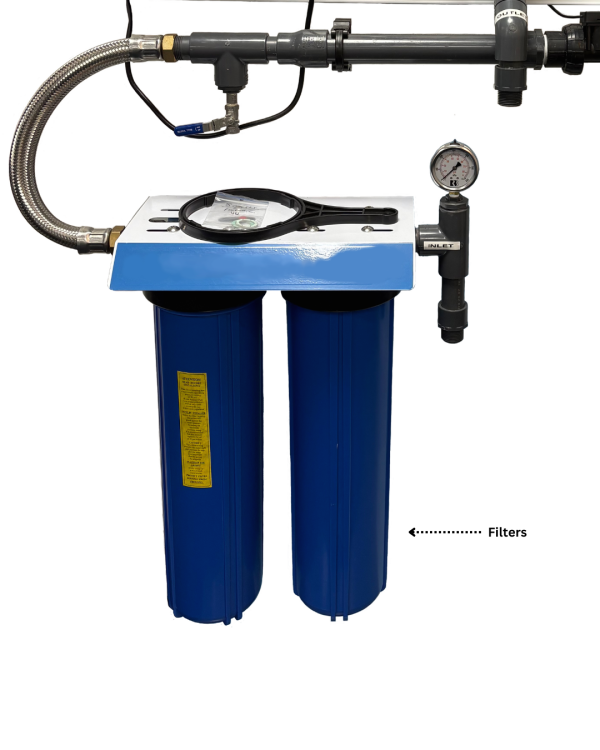 Filters catch dirt and debris so it can’t get into drinking water
Source water (e.g. from a roof, bore, lake, river, stream) passes through filters to remove dirt, debris, and larger bugs. This is an important step because UV light disinfection can only work if water is clear enough for light to reach smaller contaminants.
Use at least one cartridge filter with a pore size of five microns or less.
Keep filters working
- Check your filters every month and after weather events like floods, storms, fires and high winds.
- Replace filters if the centre is starting to look dirty or you notice a drop in water pressure.
- If you find your cartridge filter needs changing more than once a month, you might need to install extra filters.
UV light disinfection
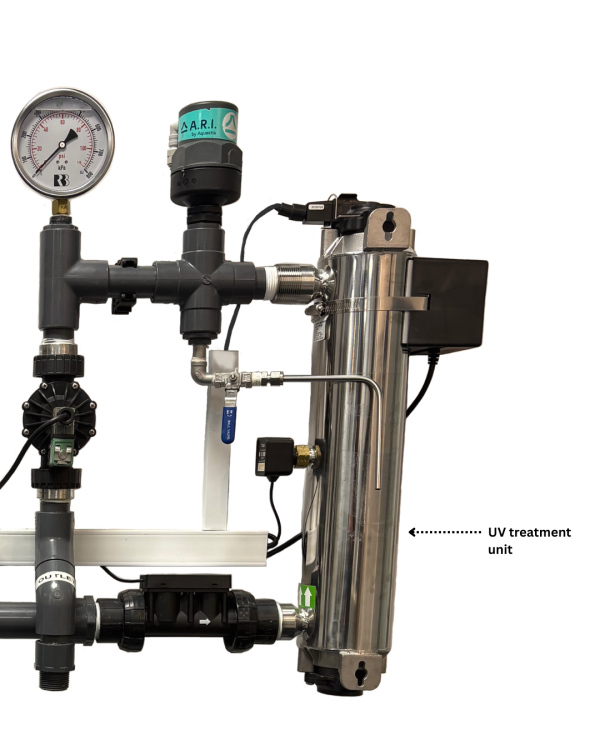 UV light kills or neutralises harmful bugs and viruses
Water moves through UV light to kill microscopic bugs like viruses, protozoa, and bacteria including E. coli, salmonella, giardia and cryptosporidium.
Recommended UV units
Effective UV treatment requires a specific balance between the intensity of light and the speed of water flowing through the unit.
The UV system should:
- deliver a minimum reduction equivalent dose of 40mJ/cm2
- restrict or monitor the flow of water through UV treatment so it meets the manufacturer’s recommended flow rate.
A plumber can install a flow restrictor to help your system achieve the right flow rate.
Schools must use a UV system that has been validated or certified to international standards.
Keep UV light working
- Check lamps once a year and replace them before they exceed their run hours. Most systems have a counter that will tell you when replacement is due.
- Check lamp sleeves at least once a year, and more frequently if your water is high in minerals. If there is any build-up, clean it away with a damp cloth. A non-abrasive cleaner can be used for stubborn build-up.
- Replace the lamp sleeve if it is damaged.
Backflow prevention
Backflow prevention is a device to stop contaminated water flowing into treated water
Backflow prevention is important for water supplies where treated drinking water is distributed for other purposes, e.g. filling stock troughs or swimming pools.
There are two main types of backflow prevention.
- Air gap. If you have a water storage tank, an air gap uses gravity to make sure contaminated water can’t make its way back into a drinking water supply.
- Valve. A dual-check valve is installed as a connection between pipes. The valve has physical barriers to stop water moving backwards.
Keep backflow prevention working
- For air gap backflow prevention, check at least once a year to make sure the overflow outlet isn’t blocked or obstructed.
- Dual-check valves should be replaced every five years.
Chlorine disinfection
Chlorine helps to keep treated water safe when it moves through pipes
If water will be distributed to others after filtration and UV treatment, a very small amount of chlorine protects against any bacteria that could enter through damaged or worn pipes.
Recommended chlorine dosing
Do not use bleach that is scented, coloured or foaming.
The dosage depends on the concentration of chlorine in the bleach you use, whether you use a storage tank, the size of your tank and how full the tank is.
Keep chlorine working
- Test twice a week with a dipstick or meter.
- If chlorine is a normal part of your water treatment, an unexpected drop in chlorine levels in drinking water could indicate there is contamination coming from a local source. Investigate what might be causing this and increase chlorine dosing to manage the risk.
Water storage tanks
Tanks are used to store water before or after it is treated
Many school water supplies use tanks to store water. They are usually made of concrete or plastic. Keeping them in good condition is important to prevent contamination and leaks.
Keep storage working
- Keep tanks clean. It’s best to clean your tank once a year.
- Stop birds and animals from getting into tanks.
- If your drinking water supply is contaminated, it’s important to flush all water out of your tank and disinfect it after you resolve the issue. This prevents any contaminated water making its way through the tap.
Pipes
Pipes carry water from source, to treatment, to taps
Drinking water pipes are usually made of plastic. Some older pipes might be copper or even lead. Pipes are sometimes called distribution or reticulation. They are a crucial part of delivering safe water because contamination can enter through damaged or worn pipes.
Keep pipes working
- Know where your pipes are. If you didn’t map your pipes when they were installed, it’s good to record any pipe locations you become aware of. GPS smartphone apps can be useful.
- Install signs to prevent damage through digging.
- Check the pipeline once a year, ideally in summer when ground is dry. Fresh or healthy grass growth in an otherwise dry area can indicate a leaking pipe.
If you are considering upgrading any equipment or employing consultants, contact the Ministry of Education’s Water Services team for advice at water.services@education.govt.nz
Test your water
It’s important to test regularly because water is dynamic and influenced by weather and human activities.
The bacteria, chemicals, dirt and algae that can show up in water all pose serious risks. Some of them can make people very sick, either through causing illness or interfering with treatment systems that protect our health.
You can learn more about possible contaminants in our Learning Hub.
In the water – Learning Hub
Maximum Acceptable Values (MAVs) for bacteria, chemicals, dirt and algae are set out in water services regulations.
Water Services (Drinking Water Standards for New Zealand) Regulations 2022 - Legislation.govt.nzoutbound
Substances that water needs to be tested for and when to test depends on your source water.
- Test school drinking water to check if your treatment system is working properly. All schools with their own water supply must test for E. coli and total coliforms every month.
Drinking water tests – Ministry of Educationoutbound
-
Test school source water to make sure your treatment system is set up to manage its unique risks from harmful germs, chemicals, metals and physical contaminants like dirt. What to test for depends on your school’s source water. See Ministry of Education guidance for more information.
Source water tests – Ministry of Educationoutbound
Schools need to use an accredited lab for water testing.
Finding and using an accredited laboratory
Informing your school board and community about water test results helps to maintain confidence in the school’s drinking water supply.
Testing is very important but it doesn’t make water safe to drink – only an effective treatment system can give you this confidence.
If test results show your school’s water has over the Maximum Acceptable Value (MAV) of any contaminant, you need to take action.
Act quickly if test results show contamination
Act quickly to protect the health of students and staff if tests find E. coli chemicals or other contamination in the drinking water supply for your school/kura. If you have any reason to suspect your water might be contaminated, don’t wait for lab results before taking action.
These are the first steps to take
- Inform students, staff and your school community that water from taps and fountains is not safe to drink.
- Put signs up near taps and fountains. Make sure nobody drinks contaminated water or uses it to prepare food.
- Download a printable Do Not Drink notice
- Provide another source of drinking water, e.g. bottled or from a water tanker.
- Notify the Water Services Authority and Ministry of Education that you have taken these steps.
- Fix any issues in your water supply system.
If you notice an increase in illness at school, contact your local public health service. Details can be found at healthnz.govt.nz/NotifiableDiseases.
For more about how schools and kura can respond to E. coli detection and make your water safe, see the Ministry of Education website.
Schools that supply their own drinking water – Ministry of Education outbound
Resources like our school-specific Do Not Drink notice and tap tags can help you communicate about drinking water contamination.
Be prepared to respond to contamination
Your school should have a plan for how leaders will respond to any issues that affect the safety of drinking water – including E. coli contamination events.
These considerations might be helpful for contamination response planning.
- Note the location of all taps and fountains in case you need to restrict access to them.
- Decide which communication channels you will use to share information about unsafe water.
- Keep treatment equipment running over holidays and breaks.
- If you need to turn your treatment system off, keep a checklist handy for steps to take when turning it back on. The Ministry of Education website has a list of maintenance checks.
Scheduled maintenance – Ministry of Education outbound - Keep the contact details of your local drinking water specialist handy so you can act quickly.